Thai Massage
Types Of Massage
When you say the word "massage" in Pattaya three types of massage come to mind.
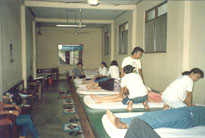
- Foot Massage
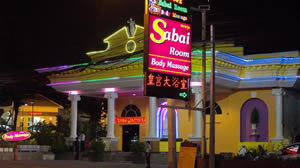
- Massage Parlor
- Traditional Thai Massage
Traditional Thai Massage
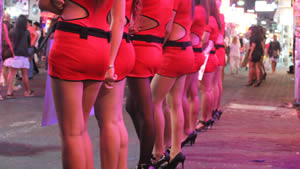
"Thai massage"-hearing those words, most people would automatically think of Bangkok's infamous nightlife and the massage parlors which offer services quite different from genuine massage. Thai massage unfortunately suffers from this reputation since very few foreign visitors arrive in Thailand already knowing that 'Traditional massage' is something totally different from the sort of thinly disguised prostitution found in Bangkok's parlors.
Traditional Thai Massage, or "Ancient Massage" NUAD PHAEN BORAN, as it is called in Thai), originates from a long history of therapeutic healing. Knowing a few Thai words can help you communicate with your massage person. If you trace the evolution of the techniques of healing-massage practiced in Thailand, you will discover the astonishing fact that the earliest roots of Thai massage lie not in Thailand but in India.
Doctor Jivaka Kumar Bhaccha
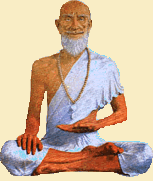
The legendary founder of the art is believed to have been a doctor from northern India. His name was Doctor Jivaka Kumar Bhaccha. He was a contemporary of the Buddha and personal physician to the Magadha King Bimbisara over 2,500 years ago.
The theoretical foundation of Thai massage is based on the concept of invisible energy lines running through the body. Ten of these lines are especially important in Thai massage: 'The 10 Sen' or SIP SEN. The Indian origin and influence becomes obvious here since the background of this theory clearly lies in Yoga philosophy.
Life Energy Pressure Points
Yoga philosophy states that life energy, called "Prana" is
absorbed with the air we breathe and with the food we eat. Along a network of
energy lines, the Prana Nadis, the human being is then supplied with this vital
energy. These energy lines are invisible and cannot be verified anatomically.
They form a sort of 'second skin', a second body in addition to the physical
body. Called Pranamaya Koshaor 'energy body', this second body is comprised
of a multitude of energy lines. It is claimed that there are 72,000 of these energy lines. However many there may be,
out of this multitude of lines, Thai massage has selected 10 mainlines
on which there are especially important acupressure points. Massaging these
points makes it possible to treat certain diseases or to relieve pain.
The 10 Sen (energy lines) are sufficient to conduct practical treatment for the whole body and
its internal organs. Western scientists are still puzzled by the fact that these lines and points do seem to have
validity. Their existence can be validated
practically by the curing of various diseases or, at the very least, by providing
relief. These points can be thought of as 'windows' into the body. These
'windows' enable an exchange of cosmic energy through which the human
body is maintained in an energy balance with the energy of the universe.
Disturbances in the flow of energy result in an insufficient supply of Prana which will in turn lead to sickness. Working on the energy lines with massage can break the blockades, stimulate the free flow of Prana, and help to restore general well-being.
Thai Massage - The Difference
Thai massage differs radically from 'Swedish Massage' (often called 'Classical Massage') which is the most widespread technique of massage in the West. That kind of massage is very much restricted to working with muscles and soft tissue. Your doctor sends you to a masseur who will knead your muscles for 15 to 30 minutes in an attempt to induce physical and emotional relaxation.
There is no doubt but that such relaxing massage plays an important role in a world dominated by haste and stress.
However in Thai massage the aspect of muscular relaxation is only a secondary goal.
Thai Traditional Massage Pressure Points
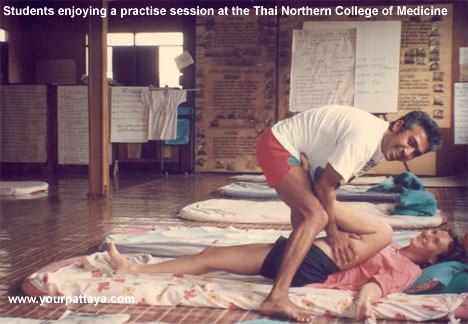
Unlike Swedish massage, traditional Thai massage does not primarily work with the physical body but rather with the energy body of man. The kneading of muscles which dominates in Swedish massage is absent from Thai massage: energy points are pressed or general pressure is used instead.
There is a lot of stretching involved and many exercises might well be described as 'applied Hatha Yoga' or 'applied physical Yoga'. Rather than using the term 'Thai massage', it wouldn't be a bad idea to actually call it' Yoga massage' since that's what this art essentially is.
The tradition is more or less lost in India nowadays, as Ayurvedic massage and Indian Yoga massage have evolved in different directions. But the Yoga background of Thai massage is obvious from all of the beautiful postures used. Physiotherapy and chiropractics in the West are closer to Thai massage than Swedish massage is, but these techniques also ignore manipulating the energy points and the energy flow of the body: their theoretical foundations are based on the anatomical structure of the body.
Reflexology
A search for massage theories and techniques in the West which are more closely parallel to Thai massage brings to mind reflexology , where a workout on energy points is done as well.
This could explain why in the last four or five years there has been a massive increase in the number of Foot Massage Shops (Reflexology Clinics) in Thailand.
Benefits of Massage
Depending on the type of work you receive, you may experience some of the following benefits from your massage session:
- Reduced pain from acute or chronic inuries & illnesses
- Decreased stress and anxiety
- Deep relaxation
- Improved body awareness
- Renewed sense of joy and well-being
- Increased motivation to practice self-care & stress management
- Improved circulation
- Increased range of motion
- Faster recovery time from exercise related soreness
- Detoxification
Masseuses
Most masseurs and masseuses in Thailand have taken a simple two or three month training course in 'Thai Traditional massage'. Some train only two or three weeks. The better training centers are in Bangkok and Chiangmai. Massage Shops in Pattaya There are many Thai Traditional Massage centers in Pattaya. One very popular center is the 'Thai Blind Massage Institute' in the Jomtien Complex Shopping Center, Telephone: 038 251851.
The Thai massage in most shops will cost you 200 baht per hour. Some of the shops have very young girls (around 19-20) who are less experienced. You have a greater chance of getting a good massage from an older masseuse around 27 to 35 years old. Our business directory lists telephone numbers and addresses of massage shops in Pattaya. If you are looking for a massage which includes sexual favours then go to our Massage Parlor page.
Related Links
Tranquilstate Tranquilstate - exclusive male grooming.
Thai Massage School of Chiang Mai
(TMC) is fully accredited by the Thai Ministry of Education to teach short Thai Massage courses.